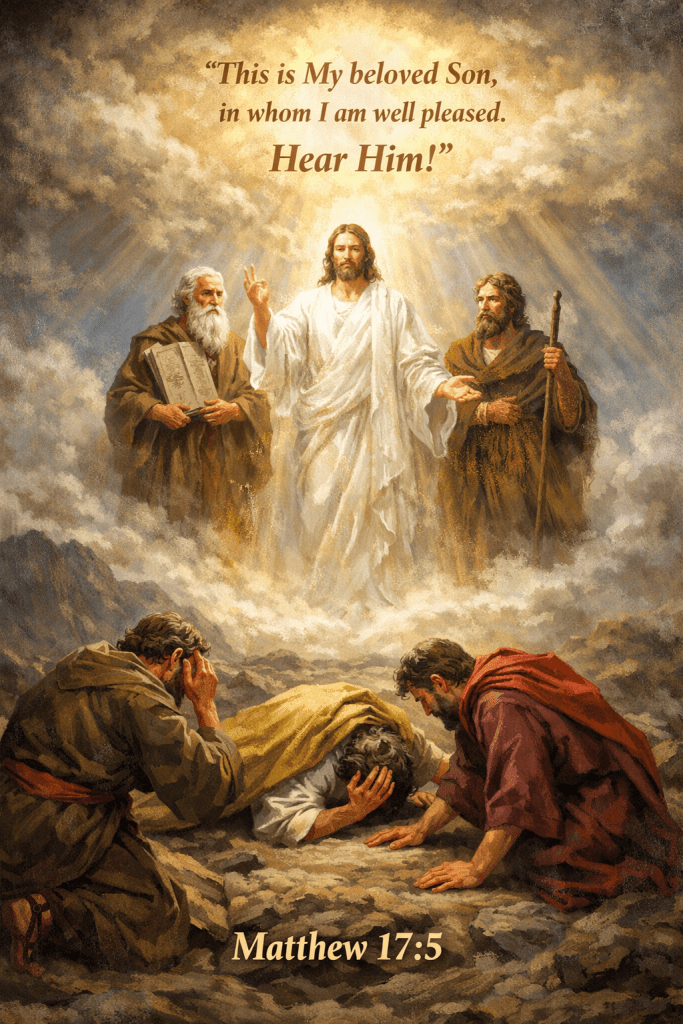
Introduction: The Moment That Silenced Everyone
Peter is talking. He’s sincere, passionate, and completely wrong.
He wants to build three tabernacles—one for Jesus, one for Moses, one for Elijah.
Before Peter can finish his sentence, God interrupts him.
This verse is not just a heavenly announcement—it is a divine correction.
The Mount of Transfiguration answers one of the most important questions of all time:
Who is Jesus, really—and how should we respond to Him?
I. The Father’s Declaration: “This Is My Beloved Son”
This is not the first time the Father says this (Matthew 3:17 at Jesus’ baptism).
But here, the context is different.
1. Not a prophet among prophets
Moses represents the Law.
Elijah represents the Prophets.
Jesus is not equal to them—He is above them.
Hebrews 1:1–2 echoes this moment:
“God… spoke in time past to the fathers by the prophets, has in these last days spoken to us by His Son.”
Jesus is not another voice in the lineup—He is the final and full revelation of God.
2. “Beloved” speaks of relationship, not just role
Jesus is not merely God’s servant—He is God’s Son.
Eternal, unique, divine.
This is a declaration of identity, not performance.
II. The Father’s Pleasure: “In Whom I Am Well Pleased”
This is stunning—because Jesus has not yet gone to the cross.
1. God’s pleasure comes before the sacrifice
The Father is pleased with the obedient life of the Son, not just the atoning death.
Jesus lived:
- In perfect obedience
- In total submission
- In complete dependence on the Father
This reminds us: obedience matters to God.
2. A preview of the cross
The Transfiguration happens right after Jesus speaks about His coming suffering (Matthew 16:21).
The glory on the mountain strengthens the disciples for the suffering ahead.
God shows them who Jesus is before showing them what Jesus will endure.
III. The Father’s Command: “Hear Him!”
This is the climax of the verse.
1. God silences competing voices
Peter wanted to preserve the moment, but God wanted to prioritize the message.
“Hear Him” means:
- Not Moses over Jesus
- Not Elijah alongside Jesus
- Not your preferences, traditions, or comfort over Jesus
Jesus alone has final authority.
2. Hearing means obedience, not admiration
In Scripture, to “hear” is to listen with the intent to obey.
James 1:22:
“Be doers of the word, and not hearers only…”
Many admire Jesus.
Many quote Jesus.
But God says: Listen to Him. Submit to Him. Follow Him.
IV. When God Speaks, We Must Respond
Verse 6 tells us the disciples fell on their faces—overwhelmed by the holiness of God.
And then Jesus does something beautiful:
“Jesus came and touched them and said, ‘Arise, and do not be afraid.’” (v.7)
The same Jesus who is glorified is also gentle.
The One the Father commands us to hear is the One who comes close.
Applications: Hearing Him Today
1. Are you listening to Jesus—or just agreeing with Him?
Agreement without obedience is not hearing.
2. Are other voices competing with His?
Culture. Fear. Comfort. Tradition. Even religious activity.
God still says: “Hear Him.”
3. Are you willing to follow Him down the mountain?
Mountaintop moments are powerful—but discipleship happens in the valley.
Conclusion: One Voice Above All Others
When the cloud lifts and the glory fades, verse 8 says:
“They saw no one but Jesus only.”
That is the goal of the Christian life.
Not Jesus plus something else.
Not Jesus among other authorities.
But Jesus only.
The Father has spoken.
The Son has been revealed.
The command still stands:
“This is My beloved Son… Hear Him.”
Maranatha! Come Lord Jesus!
 BIBLE FACTS OF THE DAY
Leave a comment