Introduction
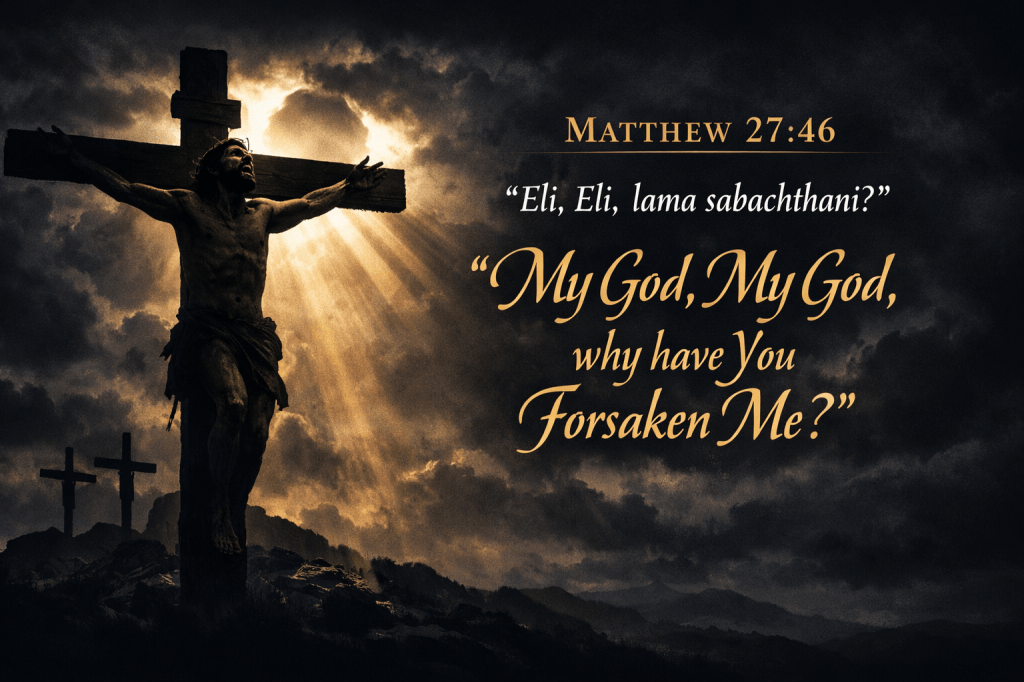
This is one of the most profound and mysterious cries ever uttered in human history. From the lips of the sinless Son of God comes a cry of abandonment.
At the very moment when Jesus is accomplishing salvation, He speaks words that seem to express separation from the Father.
This is not a cry of weakness—it is a revelation of what salvation truly cost.
I. A Cry of Fulfilled Prophecy
Jesus is quoting Psalm 22:1.
This is not random suffering—this is divine fulfillment.
- Psalm 22 describes crucifixion before crucifixion existed
- It speaks of pierced hands and feet, mocked Messiah, divided garments
When Jesus cries this, He is declaring:
“This is that moment. I am the fulfillment.”
Even in agony, Jesus is pointing us to Scripture.
Application:
God’s plan is never out of control—even in suffering, prophecy is being fulfilled.
II. A Cry of Real Suffering
Jesus says, “Why have You forsaken Me?”
This reveals the depth of His suffering:
- Physical pain from crucifixion
- Emotional pain from rejection
- Spiritual agony unlike anything ever experienced
This is not symbolic pain—this is real abandonment in experience.
The Son who had eternal fellowship with the Father now feels forsaken.
Application:
Jesus understands human suffering at the deepest level. There is no pain you experience that He cannot relate to.
III. A Cry of Substitution
This is the heart of the Gospel.
Jesus is not forsaken for His sin—He had none.
He is forsaken for our sin.
“He made Him who knew no sin to be sin for us…” (2 Corinthians 5:21)
At that moment:
- The sin of the world is placed on Christ
- The judgment of God falls on Him
- He stands in our place
The forsaking of Jesus means we never have to be forsaken.
Application:
Your sin was not ignored—it was judged in Christ.
IV. A Cry That Reveals God’s Holiness
Why would the Father “forsake” the Son?
Because God is holy.
- God cannot overlook sin
- Sin brings separation
- Jesus became the sin-bearer
This moment shows:
- The seriousness of sin
- The cost of redemption
The cross is where:
- God’s love meets God’s justice
Application:
If sin required this cost, we must never treat sin lightly.
V. A Cry That Secures Our Access to God
Because Jesus was forsaken, we are accepted.
- He was separated so we could be brought near
- He bore wrath so we could receive grace
This connects directly to the promise:
“Let us therefore come boldly to the throne of grace…” (Hebrews 4:16)
We can come near because He was cast out.
Application:
You are never alone if you are in Christ. God will never forsake you (Hebrews 13:5).
VI. A Cry That Still Speaks Today
This cry echoes through time:
- To the sinner: “This is what your salvation cost.”
- To the believer: “You are eternally secure.”
- To the suffering: “God understands your pain.”
It is both:
- A cry of agony
- A cry of victory in progress
Conclusion
At the cross, we see:
- The depth of human sin
- The holiness of God
- The love of Christ
Jesus was forsaken so that we might be forgiven.
If you have never trusted Christ:
- He took your place
- He bore your judgment
- He opened the way
Come to Him.
If you are in Christ:
- You are never forsaken
- You are fully accepted
- You are eternally loved
Closing Prayer
Lord, we stand in awe of the cross.
Thank You that Jesus was forsaken so we could be forgiven.
Help us to grasp the weight of our sin and the greatness of Your love.
Draw us closer to You with boldness and gratitude.
In Jesus’ name, Amen.
Maranatha! Come Lord Jesus!
 BIBLE FACTS OF THE DAY
Leave a comment