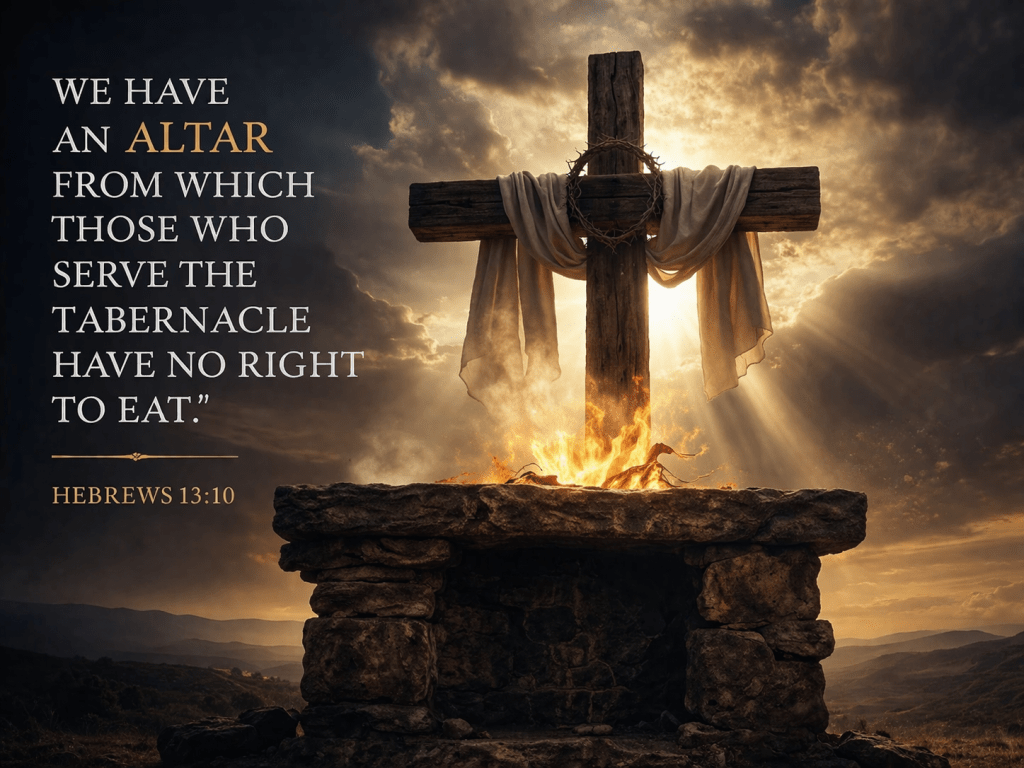
Introduction: From Altars to the Cross
Throughout the Old Testament, altars were central to worship. From Abel’s offering (Genesis 4:4) to Abraham on Mount Moriah (Genesis 22), to the tabernacle and temple sacrifices—altars were places of:
- Sacrifice
- Blood
- Atonement
- Meeting with God
But all of those altars were shadows.
They pointed forward to one final altar…
The Cross of Jesus Christ.
1. The Altar Was a Place of Sacrifice
In the Old Covenant, animals were brought to the altar.
- Innocent life was given for the guilty
- Blood was required (Leviticus 17:11)
But those sacrifices were temporary.
They had to be repeated over and over again.
Then came Jesus.
John 1:29 – “Behold, the Lamb of God who takes away the sin of the world!”
At the cross:
- Jesus became both Priest and Sacrifice
- He offered Himself
Hebrews 9:12 – “…by means of His own blood, thus securing an eternal redemption.”
The cross is not just wood—it is God’s final altar of sacrifice.
2. The Altar Required Blood
Every altar in Scripture had one thing in common:
Blood had to be shed.
Because sin demands judgment.
Hebrews 9:22 – “Without the shedding of blood there is no forgiveness of sins.”
At the cross:
- No animal died
- No substitute from the flock
God gave His own Son.
The blood of Jesus is:
- Perfect (1 Peter 1:19)
- Sinless
- Eternal in value
The cross is the only altar where the blood is sufficient forever.
3. The Altar Was a Place of Substitution
On the altar:
- The sinner deserved to die
- The animal died instead
This is substitution.
Isaiah 53:5 – “He was pierced for our transgressions…”
At the cross:
- Jesus took your place
- He bore your judgment
- He carried your sin
2 Corinthians 5:21 – “He made Him to be sin who knew no sin…”
The cross is where the innocent died for the guilty.
4. The Altar Was a Place of Fire and Judgment
Altars were not peaceful places.
They were places of:
- Fire
- Wrath
- Judgment
On the cross:
- God’s wrath against sin was poured out
- Jesus cried out: “My God, My God, why have You forsaken Me?” (Matthew 27:46)
That was not just suffering…
That was judgment.
The cross is where God judged sin completely.
5. The Altar Was a Place of Access to God
In the Old Testament:
- Only priests could approach
- Only once a year for the high priest
But after the cross:
Matthew 27:51 – “The curtain of the temple was torn in two…”
Now:
- Access is open
- The way is made clear
Hebrews 4:16 – “Let us then with confidence draw near to the throne of grace…”
The cross became the altar that opens the way to God.
6. The Cross Ended All Other Altars
When Jesus said:
“It is finished” (John 19:30)
That meant:
- No more sacrifices
- No more altars needed
- No more repeated offerings
Hebrews 10:12 – “But when Christ had offered for all time a single sacrifice for sins…”
The cross is the final altar—complete and sufficient forever.
7. Our Response to the Altar
If the cross is the altar, then what is our response?
a. Come to the altar
You don’t bring an animal…
You bring your sin, your brokenness, your life.
b. Receive the sacrifice
You cannot add to it.
You can only believe.
c. Become a living sacrifice
Romans 12:1 – “Present your bodies as a living sacrifice…”
Now we don’t die on the altar—
We live for the One who died for us.
Conclusion: The Altar Still Speaks
That cross still speaks today.
It says:
- Your sin is paid for
- Your debt is canceled
- Your way to God is open
But it also asks a question:
What will you do with the altar?
Will you walk away…
Or will you come?
Come to the cross:
- Not as a spectator
- But as a sinner in need of grace
Because the cross is not just where Jesus died…
It is the altar where you can live.
Maranatha! Come Lord Jesus!
 BIBLE FACTS OF THE DAY
Leave a comment