Introduction: The Invisible Battle
Beloved, this verse pulls back the curtain into a reality we often forget:
There is an unseen war.
Not merely political… not merely personal… but spiritual.
Here we see David, a man after God’s own heart—yet even he is not immune.
And we see Satan, not as a myth, but as an active enemy—strategic, subtle, and dangerous.
1. Satan’s Strategy: Subtle Influence, Not Force
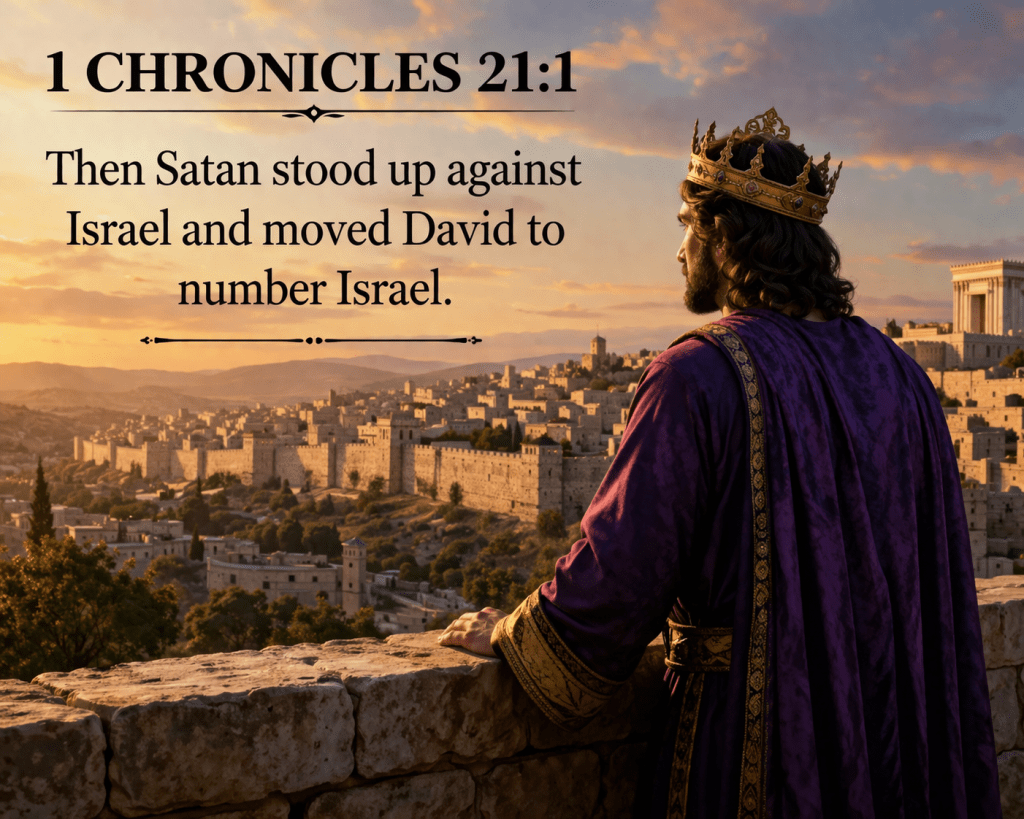
“Satan… moved David…”
Notice this carefully—Satan did not force David.
He influenced him.
That is how the enemy works:
- Not always through obvious evil
- But through reasonable thoughts with wrong motives
David decided to number Israel—a seemingly harmless act.
But beneath it was:
- Pride (“Look how strong I am”)
- Self-reliance (“I don’t need to trust God”)
- Control (“I need to measure my power”)
The enemy rarely says, “Reject God.”
Instead, he whispers:
- “You’ve got this.”
- “Count your strength.”
- “Trust yourself.”
2. A Godly Man Can Still Fall
This is not Saul. This is David.
The same David who:
- Killed Goliath
- Wrote Psalms
- Walked closely with God
Yet he fell.
Why?
Because past victories do not guarantee present obedience.
Warning
- Spiritual maturity does not eliminate temptation
- Experience does not remove vulnerability
The greatest danger is not weakness—it is overconfidence
3. The Danger of Misplaced Confidence
David wanted to count the people.
Why is this sinful?
Because Israel’s strength was never in numbers—it was in God’s presence.
When David counted:
- He shifted from faith → sight
- From dependence → independence
Contrast
- God says: “Trust Me”
- The flesh says: “Measure it”
Application
Where are you counting instead of trusting?
- Your finances?
- Your influence?
- Your abilities?
4. Conviction Comes—But Consequences Follow
After the census, David’s heart struck him.
He repented.
But judgment still came.
This teaches us:
- God forgives
- But sin still carries consequences
Key Truth
Grace does not cancel responsibility.
5. God’s Mercy is Greater Than Satan’s Attack
Though Satan initiated the temptation, he did not have the final word.
God used even this failure to:
- Bring David to repentance
- Reveal His mercy
- Establish a place of sacrifice (future temple site)
What Satan meant for destruction—God turned into redemption.
6. The Greater King Who Did Not Fall
Where David failed, another King stood firm: Hallelujah
Jesus Christ
- Satan tempted Him in the wilderness
- Offered power, control, and glory
- Yet Jesus said: “It is written”
Jesus did not trust Himself—He trusted the Father completely.
Hope for Us
- We may fall
- But Christ did not
- And through Him, we can stand
Conclusion: Guard Your Heart
1 Chronicles 21:1 is not just history—it is a warning.
Three Final Calls
1. Be Watchful
The enemy is subtle.
2. Be Humble
Strength is not in you—it is in God.
3. Be Dependent
Do not count your resources—trust your Redeemer
Closing Exhortation
If Satan could move David…
he will try to move you.
But today, choose differently:
- Do not walk by sight
- Do not trust your strength
- Do not measure your worth by numbers
Trust the Lord fully.
Closing Prayer
Lord,
Guard our hearts from pride and self-reliance.
Help us to discern the enemy’s voice and reject it.
Teach us to trust You—not in what we see, but in who You are.
And when we fall, draw us back quickly by Your mercy.
In Jesus’ name, Amen.
Maranatha! Come Lord Jesus!
 BIBLE FACTS OF THE DAY
Leave a comment