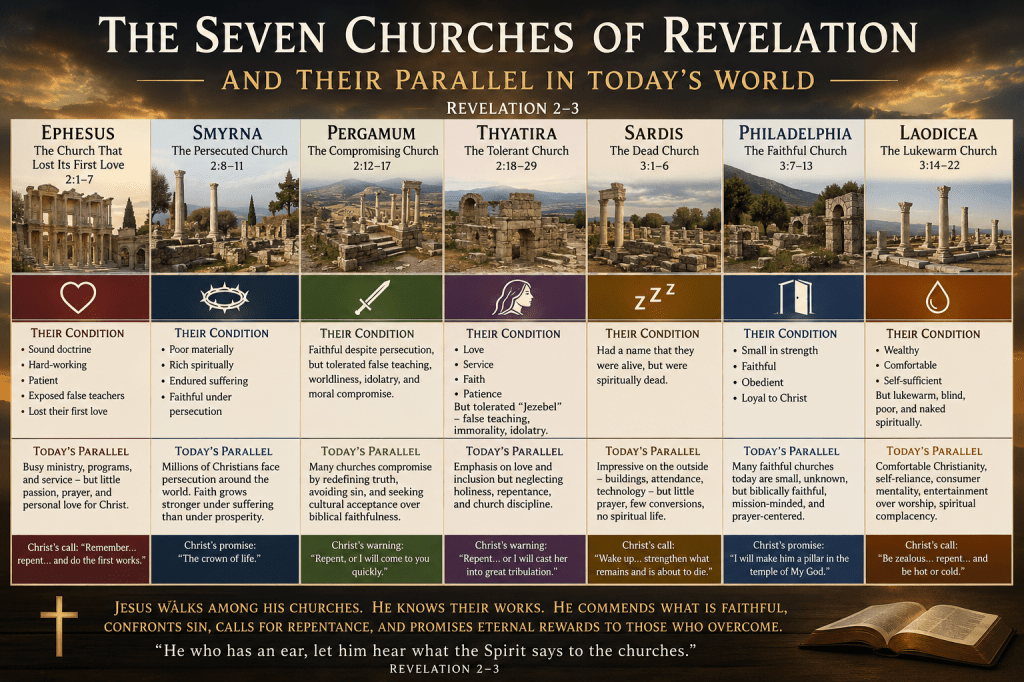
In the Book of Revelation 1:13, John saw Lord Jesus Christ standing in the midst of seven lampstands. The seven lampstands are the seven churches mentioned in Revelation 2–3. They were real congregations in Asia Minor (modern-day Turkey), but their spiritual conditions also provide timeless lessons for the Church in every generation. While Christians differ on whether these churches also represent successive periods of church history, nearly all agree that they reveal patterns that can be seen in churches and individual believers today.
1. Ephesus – The Church That Lost Its First Love
Revelation 2:1–7
Their Condition
- Sound doctrine
- Hard-working
- Patient
- Exposed false teachers
- But they had left their first love for Christ.
Today’s Parallel
Many churches today:
- Teach sound biblical doctrine.
- Have excellent worship teams, ministries, and programs.
- Are busy serving.
Yet:
- Prayer meetings are sparsely attended.
- Personal devotion is weak.
- Love for Christ has been replaced by routine.
Modern danger: Serving Jesus without loving Jesus.
Christ’s command
“Remember… repent… and do the first works.”
2. Smyrna – The Persecuted Church
Revelation 2:8–11
Their Condition
- Poor materially
- Rich spiritually
- Endured suffering
- Faithful under persecution
Today’s Parallel
Millions of Christians today face persecution in countries such as:
- North Korea
- Afghanistan
- Nigeria
- Iran
- China
Meanwhile, many believers in the Western world struggle more with comfort than persecution.
Modern lesson
Faith often grows stronger under suffering than under prosperity.
3. Pergamum – The Compromising Church
Revelation 2:12–17
Their Condition
They remained faithful despite persecution but tolerated false teaching.
They accepted:
- Worldliness
- Idolatry
- Moral compromise
Today’s Parallel
Many churches compromise by:
- Redefining biblical morality.
- Avoiding preaching about sin.
- Seeking cultural acceptance above biblical faithfulness.
- Blending secular values with Christian doctrine.
Modern danger
Truth mixed with error.
4. Thyatira – The Tolerant Church
Revelation 2:18–29
Their Strengths
- Love
- Service
- Faith
- Patience
Their Weakness
They tolerated “Jezebel,” a false teacher who promoted immorality and idolatry.
Today’s Parallel
Many churches emphasize:
- Love
- Inclusion
- Acceptance
But neglect:
- Holiness
- Church discipline
- Repentance
Love without truth eventually becomes compromise.
5. Sardis – The Dead Church
Revelation 3:1–6
Their Reputation
“They had a name that they were alive.”
Reality:
They were spiritually dead.
Today’s Parallel
Some churches have:
- Beautiful buildings
- Large attendance
- Impressive technology
- Strong reputations
Yet:
- Little prayer
- Few conversions
- Minimal spiritual growth
- Formal religion without spiritual life
Modern danger
Looking alive while being spiritually lifeless.
6. Philadelphia – The Faithful Church
Revelation 3:7–13
Their Condition
- Small in strength
- Faithful
- Obedient
- Loyal to Christ
Jesus had no rebuke for this church.
Today’s Parallel
Many faithful churches today are:
- Small
- Unknown
- Biblically faithful
- Mission-minded
- Prayer-centered
They may never become famous, yet Christ delights in their faithfulness.
Lesson
God values faithfulness more than size.
7. Laodicea – The Lukewarm Church
Revelation 3:14–22
Their Condition
- Wealthy
- Comfortable
- Self-sufficient
Spiritually:
- Lukewarm
- Blind
- Poor
- Naked
Today’s Parallel
Perhaps the closest picture of much of modern Western Christianity which is followed by many nations today.
Characteristics include:
- Material prosperity
- Comfortable Christianity
- Little dependence on God
- Entertainment replacing worship
- Consumer mentality
- Minimal sacrifice
- Spiritual complacency
People often assume that financial success or large numbers indicate God’s approval, yet Jesus told the Laodiceans that despite their wealth they were spiritually needy.
Modern danger
Being satisfied with religion while lacking genuine fellowship with Christ.
A Summary Comparison
| Church | Main Problem | Modern Reflection |
| Ephesus | Lost first love | Busy ministry without deep devotion |
| Smyrna | Persecution | Faithfulness amid suffering |
| Pergamum | Compromise | Blending biblical truth with worldly values |
| Thyatira | Tolerating false teaching | Acceptance without holiness |
| Sardis | Spiritual deadness | Outward success but inward emptiness |
| Philadelphia | Faithfulness | Obedience despite limited strength |
| Laodicea | Lukewarmness | Comfort, self-sufficiency, spiritual complacency |
What These Churches Teach the Church Today
The seven churches remind us that Jesus is not only the Savior of the Church but also its Lord. He walks among His churches, knows their works, commends what is faithful, confronts sin, calls for repentance, and promises eternal rewards to those who overcome (Revelation 2–3).
Several enduring principles emerge:
- Christ evaluates churches by their spiritual faithfulness, not merely by their size, wealth, influence, or reputation.
- To Christ it does not matter whether you belong to a Baptist, or a Methodist or a non-denominational group or thousand other denominations.
- Sound doctrine and genuine love must remain together.
- Holiness should accompany grace, and truth should be expressed in love.
- Persecution can strengthen faith, while prosperity can tempt believers toward self-reliance.
- Every generation must guard against compromise and spiritual complacency.
- Faithful endurance, even in weakness or obscurity, is precious in Christ’s sight.
Many Bible teachers observe that elements of all seven churches can be found in today’s Christian world—and even within an individual believer’s life. Rather than asking only, “Which church describes our congregation?” it is helpful to ask, “Which church most closely describes my own walk with Christ today?”
The repeated appeal at the end of each letter remains just as relevant now as it was in the first century:
“He who has an ear, let him hear what the Spirit says to the churches.” (Revelation 2–3)
Maranatha! Come Lord Jesus!


Leave a comment