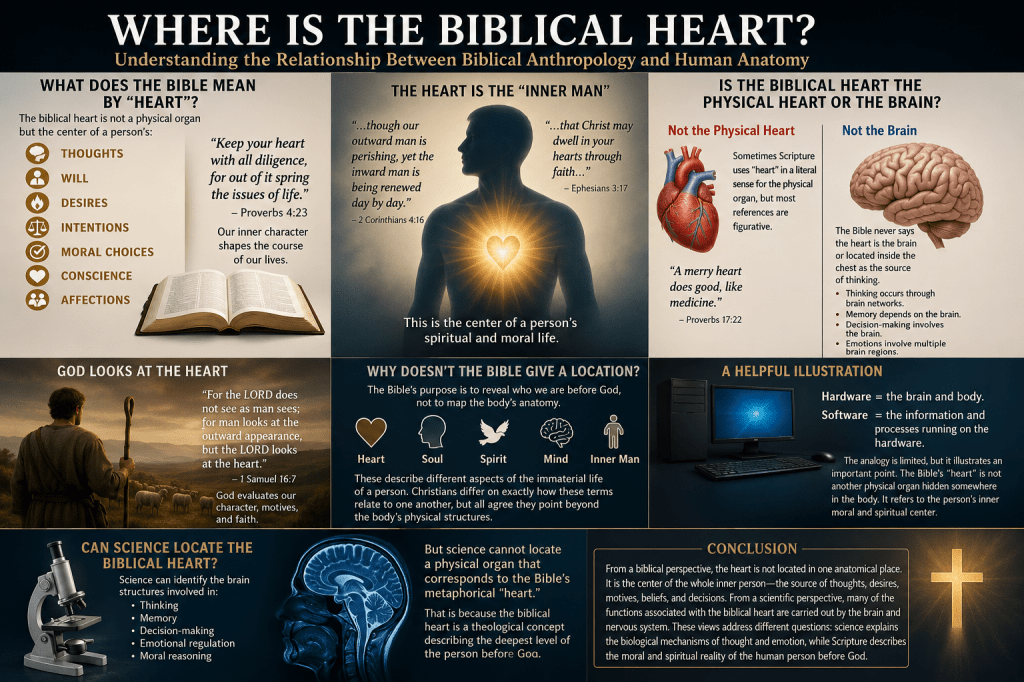
Before we learn about what the Bible says about anger, let us look at the relationship between biblical anthropology (what the Bible teaches about human nature) and human anatomy.
The short answer is:
The Bible does not identify a physical location for the “heart” as the center of a person’s spiritual and moral life. The biblical heart is not an anatomical organ but a description of the inner person.
Several passages in the Bible mention about a man’s heart:
- Psalm 139:23: Search me, O God, and know my heart;
- Jeremiah 17:9: The heart is deceitful above all things,
- Psalm 51:10: Create in me a clean heart, O God,
- Matthew 5:8: Blessed are the pure in heart,
- Proverbs 3:5: Trust in the Lord with all your heart,
What Does the Bible Mean by “Heart”?
The Hebrew word lēḇ and the Greek word kardia usually refer to the center of a person’s:
- Thoughts
- Will
- Desires
- Intentions
- Moral choices
- Conscience
- Affections
It is the “control center” of a person’s spiritual life.
For example:
“Keep your heart with all diligence, for out of it spring the issues of life.” — Proverbs 4:23
The verse is not teaching that blood flowing from the physical heart determines our conduct. Rather, it teaches that our inner character shapes the course of our lives.
Is the Biblical Heart the Physical Heart?
Sometimes Scripture uses “heart” in a literal sense to refer to the physical organ, but most references are figurative.
For example:
“A merry heart does good, like medicine.” — Proverbs 17:22
This speaks about one’s inner disposition, even though emotions can have real physical effects.
Is the Biblical Heart the Brain?
The Bible never says the heart is the brain.
Likewise, it never says it is located inside the chest as the source of thinking.
Today, neuroscience as we read in Part I, shows that:
- Thinking occurs through brain networks.
- Memory depends on the brain.
- Decision-making involves the brain.
- Emotions involve multiple brain regions, including the amygdala, prefrontal cortex, and other interconnected areas.
The biblical writers were not giving a lesson in anatomy. They were describing the whole inner person in theological and moral terms.
The Heart Is the “Inner Man”
Paul wrote:
“…though our outward man is perishing, yet the inward man is being renewed day by day.” — 2 Corinthians 4:16
The “heart” belongs to this inward person.
Similarly,
“…that Christ may dwell in your hearts through faith…” — Ephesians 3:17
Jesus is not described as dwelling in the physical heart muscle. Rather, He dwells in the believer’s inner life through faith.
God Looks at the Heart
When God chose David, He said:
“For the LORD does not see as man sees; for man looks at the outward appearance, but the LORD looks at the heart.” — 1 Samuel 16:7
God was evaluating David’s character, motives, and faith—not examining a physical organ.
Why Doesn’t the Bible Give a Location?
The Bible’s purpose is to reveal who we are before God, not to map the body’s anatomy.
It uses words such as:
- Heart
- Soul
- Spirit
- Mind
- Inner man
These describe different aspects of the immaterial life of a person.
Think of a computer:
- Hardware = the brain and body.
- Software = the information and processes running on the hardware.
The analogy is limited, but it illustrates an important point. The Bible’s “heart” is not another physical organ hidden somewhere in the body. It refers to the person’s inner moral and spiritual center. Unlike software, however, the biblical heart is not merely information—it encompasses the whole inner life, including one’s relationship with God.
Can Science Locate the Biblical Heart?
Science can identify the brain structures involved in:
- Thinking
- Memory
- Decision-making
- Emotional regulation
- Moral reasoning
But science cannot locate a physical organ that corresponds to the Bible’s metaphorical “heart.”
That is because the biblical heart is a theological concept describing the deepest level of the person before God.
Conclusion
From a biblical perspective, the heart is not located in one anatomical place. It is the center of the whole inner person—the source of thoughts, desires, motives, beliefs, and decisions. From a scientific perspective, many of the functions associated with the biblical heart are carried out by the brain and nervous system. These views address different questions: science explains the biological mechanisms of thought and emotion, while Scripture describes the moral and spiritual reality of the human person before God.
Maranatha! Come Lord Jesus!


Leave a comment