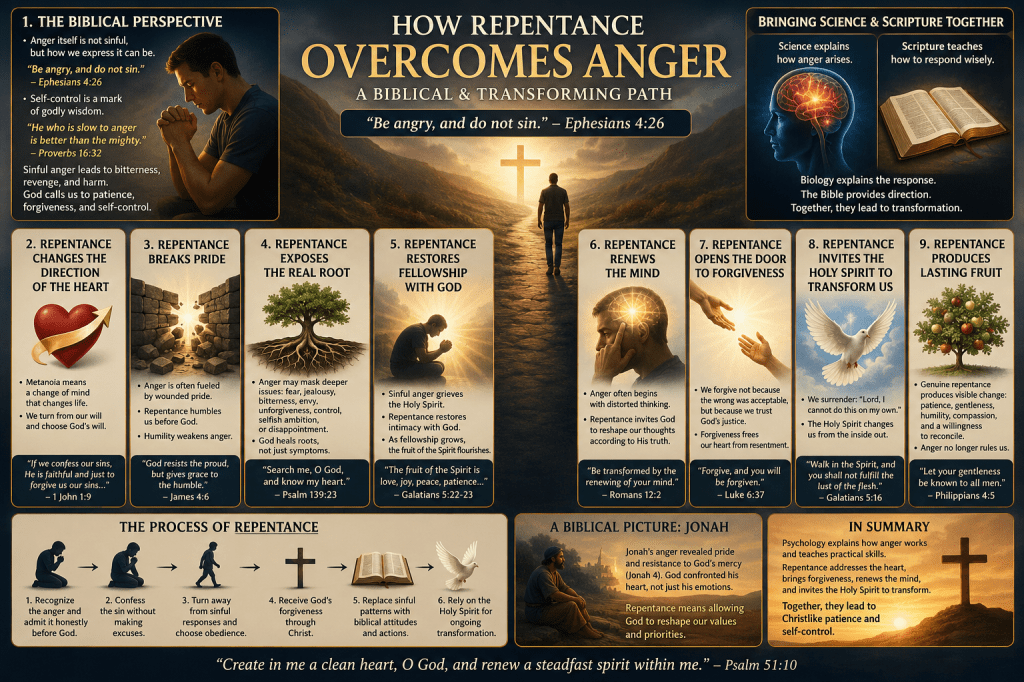
1. The Biblical Perspective
The Bible recognizes that anger itself is not always sinful.
“Be angry, and do not sin.” — Ephesians 4:26
This verse distinguishes the emotion of anger from sinful expressions of anger.
Scripture also encourages self-control:
“He who is slow to anger is better than the mighty.” — Proverbs 16:32
From a biblical perspective, anger becomes harmful when it leads to bitterness, hatred, revenge, or uncontrolled speech and actions. Instead, believers are called to allow the Holy Spirit to cultivate patience, gentleness, forgiveness, and self-control.
Bringing Science and Scripture Together
Modern neuroscience explains how anger arises—through the interaction of brain circuits, hormones, and the body’s stress response. Scripture addresses how to respond to anger, calling people to wisdom, self-control, and reconciliation. Together, they offer complementary insights: biology helps explain the emotional response, while biblical teaching provides moral and spiritual guidance for directing it in healthy and God-honoring ways.
Repentance is one of the most powerful biblical remedies for overcoming anger because it does far more than modify behavior—it addresses the heart, where Jesus taught sinful attitudes originate (see Matthew 15:18–20). While psychology often focuses on managing anger, repentance seeks transformation by bringing the heart into alignment with God.
2. Repentance Changes the Direction of the Heart
The New Testament word for repentance, metanoia, means “a change of mind” that results in a change of life.
When someone repents of sinful anger, they are saying:
- “Lord, my anger has become sinful.”
- “I have placed myself at the center instead of You.”
- “I want Your will instead of my own.”
Instead of defending anger, repentance brings it into God’s light.
“If we confess our sins, He is faithful and just to forgive us our sins and to cleanse us from all unrighteousness.” — 1 John 1:9
3. Repentance Breaks Pride
Many angry reactions are fueled by wounded pride.
We think:
- “I deserve better.”
- “They can’t treat me that way.”
- “I’ll make them pay.”
Repentance humbles us before God.
It shifts the focus from:
- “What they did to me”
to:
- “Lord, what are You teaching me?”
Humility weakens anger because pride is no longer controlling the heart.
“God resists the proud, but gives grace to the humble.” — James 4:6
4. Repentance Exposes the Real Root
Anger is often not the deepest problem.
It may be masking:
- Fear
- Jealousy
- Bitterness
- Envy
- Unforgiveness
- Control
- Selfish ambition
- Disappointment
Repentance asks God to uncover those deeper issues.
King David prayed:
“Search me, O God, and know my heart.” — Psalms 139:23
God heals roots, not just symptoms.
5. Repentance Restores Fellowship with God
Sinful anger grieves the Holy Spirit.
When believers continue in bitterness, they often experience:
- Loss of joy
- Lack of peace
- Spiritual dryness
- Difficulty praying
- Broken relationships
Repentance restores intimacy with God.
As fellowship deepens, the fruit of the Spirit grows.
Instead of anger controlling us, God produces:
- Love
- Joy
- Peace
- Patience
- Kindness
- Goodness
- Faithfulness
- Gentleness
- Self-control
(See Galatians 5:22–23.)
6. Repentance Renews the Mind
Anger often begins with distorted thinking.
For example:
“They always disrespect me.”
“They never appreciate me.”
“I have every right to hate them.”
Repentance invites God to reshape those thoughts according to His truth.
“Be transformed by the renewing of your mind.” — Romans 12:2
As the mind changes, emotional responses gradually change as well.
7. Repentance Opens the Door to Forgiveness
Many people remain angry because they continue rehearsing the offense.
Repentance leads us to forgive—not because the wrong was acceptable, but because we entrust justice to God.
Jesus taught:
“Forgive, and you will be forgiven.” — Luke 6:37
Forgiveness releases the burden of carrying resentment.
8. Repentance Invites the Holy Spirit to Transform Us
Human determination alone can restrain anger for a time, but Scripture teaches that lasting transformation comes through God’s work within us.
Repentance is an act of surrender:
“Lord, I cannot overcome this on my own. Change me from the inside out.”
The Holy Spirit gradually reshapes our character to reflect Christ.
“Walk in the Spirit, and you shall not fulfill the lust of the flesh.” — Galatians 5:16
9. Repentance Produces Lasting Fruit
Repentance is not merely feeling guilty after an angry outburst.
According to Scripture, genuine repentance produces visible change.
Over time, a repentant believer begins to show:
- Greater patience
- A slower temper
- Gentler speech
- Humility
- Compassion
- A willingness to reconcile
- Greater dependence on God
This does not mean they never feel anger. Rather, anger no longer rules them.
The Process of Repentance
Overcoming sinful anger is often a repeated process rather than a single moment:
- Recognize the anger and admit it honestly before God.
- Confess the sin without making excuses.
- Turn away from sinful responses and choose obedience.
- Receive God’s forgiveness through Christ.
- Replace sinful patterns with biblical attitudes and actions.
- Rely on the Holy Spirit for ongoing transformation.
A Biblical Picture
Consider Jonah. His anger after God’s mercy toward Nineveh revealed deeper issues of pride, resentment, and resistance to God’s compassion (Jonah 4). God confronted Jonah’s heart, not merely his emotions. The lesson is that repentance involves allowing God to reshape our values and priorities, not just suppressing angry feelings.
In summary, psychology can help explain how anger works and teach practical regulation skills. Repentance addresses why sinful anger takes hold and points believers toward lasting transformation through confession, forgiveness, renewed thinking, and the sanctifying work of the Holy Spirit. Together, wise emotional practices and genuine repentance can help a person grow in Christlike patience and self-control.
Maranatha! Come Lord Jesus!


Leave a comment