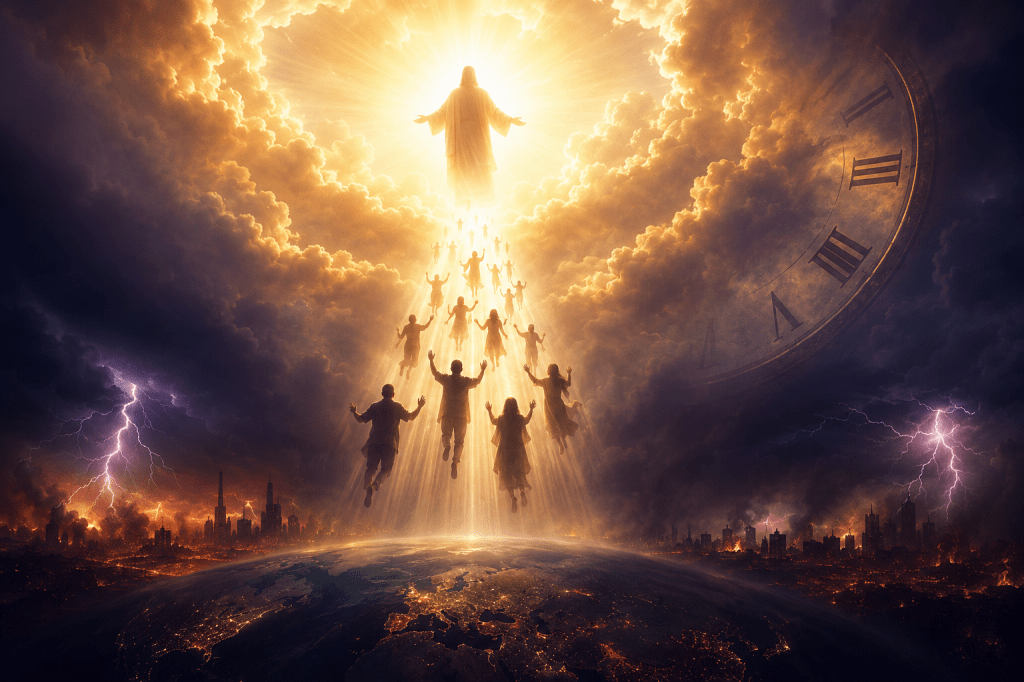
The pre-tribulation rapture view holds that Christ will gather His Church before the final Tribulation period, followed later by Christ’s visible return to earth in judgment and kingdom glory.
There is a strong biblical case for the pre-tribulation position, but Scripture never contains the single sentence, “The rapture will occur before the Tribulation.” The position comes from putting several passages together. Faithful Christians who affirm Christ’s return have interpreted the timing differently.
Here are some of the strongest arguments for the pre-tribulation interpretation.
1. The Church is promised deliverance from coming wrath
One of the foundational passages is 1 Thessalonians 1:10:
“…to wait for His Son from heaven, whom He raised from the dead, even Jesus who delivers us from the wrath to come.”
Then Paul says in 1 Thessalonians 5:9:
“For God did not appoint us to wrath, but to obtain salvation through our Lord Jesus Christ.”
This becomes significant because immediately before discussing the Day of the Lord in chapter 5, Paul describes believers being caught up to Christ in 1 Thessalonians 4:16–17.
The pre-tribulation interpretation sees a deliberate sequence:
Christ gathers His Church → believers are with Christ → the Day of the Lord’s judgment comes upon the world.
The argument is not that Christians never experience persecution. Jesus explicitly taught that believers would suffer tribulation in the ordinary sense (John 16:33).
The distinction is between persecution from the world and eschatological divine wrath upon the world.
2. Revelation 3:10 contains an important promise
Jesus tells the church at Philadelphia:
“Because you have kept My command to persevere, I also will keep you from the hour of trial which shall come upon the whole world…”
— Revelation 3:10
Notice that Christ does not merely say:
“I will protect you during the trial.”
He says:
“I will keep you from the hour of trial.”
And this particular trial is described as coming:
“upon the whole world, to test those who dwell on the earth.”
Pre-tribulation interpreters therefore understand this as deliverance from the very period of worldwide testing, not merely preservation while experiencing it.
That distinction is one of the stronger textual arguments for the position.
3. The rapture is presented as imminent
Jesus repeatedly commands His followers to watch.
Paul likewise describes believers as waiting for Christ.
Philippians 3:20 says:
“For our citizenship is in heaven, from which we also eagerly wait for the Savior, the Lord Jesus Christ.”
Titus 2:13 says:
“looking for the blessed hope and glorious appearing of our great God and Savior Jesus Christ.”
And 1 Thessalonians 1:10 describes Christians as waiting:
“for His Son from heaven.”
Pre-tribulation theology argues that the Church is told to expect Christ, rather than first expecting the Antichrist, the abomination of desolation, or the judgments described in Revelation.
This produces the doctrine commonly called imminence:
Nothing on the prophetic calendar must necessarily occur before Christ gathers His Church.
If the Church must first pass through a clearly identifiable seven-year Tribulation, then once that period begins, Christ’s coming for the Church would no longer have the same sense of imminence.
4. The rapture and Second Coming have notable differences
Compare 1 Thessalonians 4:16–17 with passages describing Christ’s return in judgment.
At the rapture:
“we… shall be caught up… in the clouds to meet the Lord in the air.”
The movement is:
Earth → believers caught up → Christ in the air.
But in Zechariah 14:4, concerning the Lord’s coming:
“And in that day His feet will stand on the Mount of Olives…”
And Revelation 19 portrays Christ descending triumphantly in judgment.
Pre-tribulation interpreters therefore distinguish:
Rapture
Christ comes for His saints.
Second Coming
Christ returns with His saints.
That distinction becomes especially interesting in Revelation 19.
5. The saints are already with Christ when He returns
Revelation 19 describes the marriage of the Lamb before Christ descends to earth.
Revelation 19:7 says:
“Let us be glad and rejoice and give Him glory, for the marriage of the Lamb has come…”
Then verse 8 describes the bride clothed in:
“fine linen, clean and bright.”
A few verses later, Christ comes from heaven.
Revelation 19:14:
“And the armies in heaven, clothed in fine linen, white and clean, followed Him on white horses.”
Pre-tribulation interpreters see a significant sequence:
The Bride is in heaven.
The marriage occurs.
Then Christ descends from heaven accompanied by heavenly saints.
This fits naturally with the Church having previously been gathered to Christ.
6. Jesus said He would take believers to the Father’s house
John 14:2–3 is especially important:
“In My Father’s house are many mansions… I go to prepare a place for you.”
Then Jesus promises:
“I will come again and receive you to Myself; that where I am, there you may be also.”
Notice the direction of the promise.
Jesus goes to the Father’s house.
He prepares a place.
He returns for His disciples.
He receives them to Himself.
Pre-tribulation theology sees this fitting naturally with 1 Thessalonians 4:
“caught up together with them in the clouds to meet the Lord in the air.”
The Church meets Christ and is taken to the place He has prepared.
7. Daniel’s seventieth week particularly concerns Israel
Daniel 9:24 says:
“Seventy weeks are determined for your people and for your holy city…”
Gabriel is speaking to Daniel.
Therefore:
“your people” = Daniel’s people, Israel.
“your holy city” = Jerusalem.
The final “week” of Daniel 9:27 is therefore interpreted by dispensational pre-tribulation theology as God’s final seven-year prophetic program involving Israel and Jerusalem.
This becomes important because the Church is a distinct New Testament body formed at Pentecost.
Pre-tribulationism therefore sees a transition:
Church age → Rapture → Daniel’s seventieth week → Christ’s return → Kingdom.
This is one reason the distinction between Israel and the Church is foundational to classic pre-tribulation theology.
8. The Church is conspicuously absent from Revelation’s judgment section
This is an argument from literary structure and therefore should not be overstated, but it is interesting.
The word church/churches occurs repeatedly in Revelation 1–3.
Jesus repeatedly says:
“He who has an ear, let him hear what the Spirit says to the churches.”
Then Revelation 4:1 begins:
“After these things…”
John is called upward:
“Come up here…”
From Revelation 6 onward, enormous judgments fall upon the earth.
Yet the church as church is no longer addressed the way it was in chapters 1–3.
The Church appears prominently again in the imagery surrounding Christ’s heavenly bride and return.
Pre-tribulation interpretation sees this pattern as consistent with the Church having been removed before those judgments.
However, Revelation still speaks repeatedly of saints during the Tribulation, which pre-tribulationists generally understand as people who come to faith during that period.
9. Noah and Lot provide a pattern of removal before judgment
Jesus compared the days surrounding His coming to Noah and Lot.
Luke 17:26–27 describes Noah entering the ark before the flood destroyed the wicked.
Even more striking is Lot.
The angels tell Lot in Genesis 19:22:
“Hurry, escape there. For I cannot do anything until you arrive there.”
Lot was removed before judgment fell upon Sodom.
Likewise, 2 Peter 2:9 says:
“the Lord knows how to deliver the godly out of temptations and to reserve the unjust under punishment for the day of judgment.”
Pre-tribulationists see a recurring biblical pattern:
God distinguishes His people → God removes or protects them → judgment falls.
These accounts are typological support, however, rather than decisive proof of rapture timing.
10. The Thessalonians were comforted by the rapture
After describing the rapture, Paul says:
“Therefore comfort one another with these words.”
— 1 Thessalonians 4:18
The message was intended as comfort.
Pre-tribulationists argue that the natural expectation Paul gives the Church is not:
“Prepare first to experience God’s catastrophic end-time judgments.”
Instead:
Wait for Christ.
That is why Titus 2:13 calls Christ’s appearing:
“the blessed hope.”
But what about Matthew 24:29–31?
This is one of the strongest passages raised against pre-tribulationism.
Jesus says:
“Immediately after the tribulation of those days…”
and then:
“they will see the Son of Man coming on the clouds of heaven with power and great glory.”
Then angels:
“will gather together His elect…”
Post-tribulation interpretation understandably sees this as the gathering of the Church.
Pre-tribulation interpreters answer that Matthew 24 is heavily situated within Israel/Judea/Jerusalem imagery:
Jesus refers to:
- Daniel the prophet.
- The abomination of desolation.
- Judea.
- Flight from Jerusalem.
- The Sabbath.
- The elect.
- The coming Messianic kingdom.
Therefore, they distinguish Matthew 24:31’s gathering associated with Christ’s public return from the Church’s catching away in 1 Thessalonians 4.
This is one of the places where the disagreement genuinely turns on interpretation rather than an explicit verse saying “pre-tribulation” or “post-tribulation.”
The prophetic sequence
The pre-tribulation understanding can therefore be summarized:
1. The Church Age — now
↓
2. The Rapture — 1 Thessalonians 4:16–17
↓
3. The Church with Christ
↓
4. Daniel’s Seventieth Week / Tribulation
↓
5. Christ visibly returns in glory — Revelation 19
↓
6. Christ establishes His kingdom
The strength of pre-tribulationism is therefore cumulative. No single argument establishes the entire system. Rather, proponents believe the pieces fit together: the Church waiting imminently for Christ, deliverance from coming wrath, Revelation 3:10, Daniel’s seventieth week concerning Israel, the Church meeting Christ in the air, the saints appearing with Christ at His public return, and the differing descriptions of the rapture and Second Coming.
But there is an even more important conclusion.
The New Testament never tells Christians to calculate the date of the rapture.
It tells us to be ready for Christ.
“Therefore you also be ready, for the Son of Man is coming at an hour you do not expect.”
— Matthew 24:44
The great hope of the Church is ultimately not pre-tribulationism.
The great hope of the Church is Jesus Christ Himself.
Whether someone holds a pre-, mid-, pre-wrath, or post-tribulation position, the essential proclamation remains:
Christ died.
Christ rose again.
Christ is coming again.
And those who belong to Him will ultimately be “always with the Lord” (1 Thessalonians 4:17).
Maranatha! Come Lord Jesus!


Leave a comment